Introduction
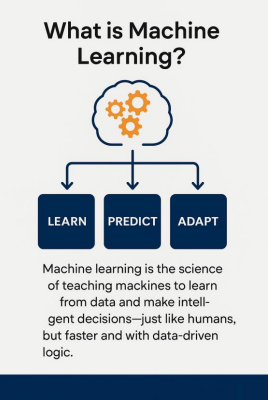
Artificial Intelligence (AI) is rapidly changing the
way we do everything in modern life and it applies
to online shopping, disease diagnosis by doctors
among others. With this change comes one of the
most essential and active AI subsets, the Machine
Learning (ML). In contrast to the classic systems
that work in accordance with the strictly
programmed rules, ML enables the machines to learn
based on the information, adjust to the new data, and
come up with intelligent conclusions. And that is just
by using machine learning to help you in the way in
which your smartphone knows what you are going to
type next or a smart home helper listening to what
you are saying.
Machine Learning is now the driving force behind most of the trendy technologies that
we currently use. As an example, Google maps utilize ML to provide the best routes
according to current traffic. Netflix also employs it to track your watch-viewing history
and recommend what you may be inclined to watch. Artificial intelligence: Using a
machine learning model, virtual assistants, such as Alexa/Siri, are programmed to hear,
understand, and react to a conversation.
These systems do not operate on definite sets of
rules. Rather they keep getting better and better through the analysis of patterns in large
volumes of data. The more experienced they turn out to be with the information coming
to them, the smarter and efficient they end up being.
By the end of this article, you will understand:
- What Machine Learning is and why it matters
- How ML differs from traditional programming
- Common ML algorithms and how they work
- Simple examples using Python and Scikit-learn
- Practical applications across industries
What is Machine Learning?
Foundations of Artificial Intelligence (AI) Machine Learning is a subfield of Artificial
Intelligence (AI) that can be described as the ability of the computers to learn as opposed
to be conditioned to perform specific tasks explicitly. Conventional software is based on
rules that are coded by a human being, by hand: all the conditions, all the logic should be
coded by the programmer. Machine learning, in its turn, enables an application to detect
patterns, make conclusions, and even gain improvements over time since it processes
enormous quantities of data. It is this flexibility which makes ML extremely powerful
under whatever conditions the specification of every possible rule is too complex or
simply impossible.
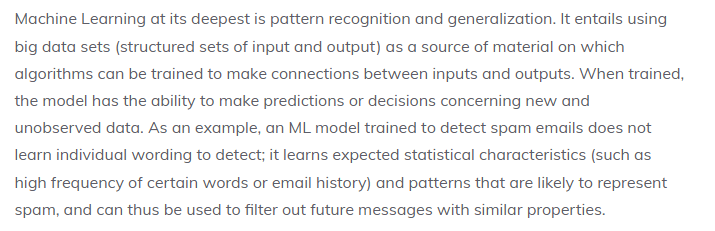
Probably the greatest part of ML is how adaptable and scalable it is. The higher the
volume of data a model will get, the easier it will find out minor differentiation and
trends. This capacity is what spurs most practical uses in the real world- recommendation
systems on Netflix’s, fraud detection in banks to name but a few.
ML is not only about
automation; it is about designing systems which can think and learn in an autonomous
way by themselves, and thus one of the most influential technologies in the current digital
environment.
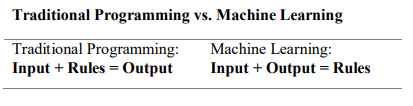
In traditional programming, a developer writes rules and instructions to transform input
into output. In machine learning, the algorithm is fed input data and the corresponding
output (known as labels), and it learns the underlying rules by itself.
Real-Life Examples of Machine Learning
Email Spam Filtering
Financial Forecasting
Streaming Recommendations
E-commerce
Self-driving Cars
Agriculture
Key Components of ML
- Dataset: A collection of data points used for training and testing. It consists of features
(input variables) and labels (output variables). - Training and Testing: The dataset is split into training and testing sets. The model
learns from the training set and is evaluated on the testing set. - Algorithms: Mathematical formulas or procedures used to identify patterns in data
Simple ML Model in Python
Python Code Example:
from sklearn import tree
Data: [height, weight]
X = [[160, 50], [165, 65], [170, 70], [155, 45], [185, 90], [175, 85]]
y = [0, 0, 1, 0, 1, 1] # 0 = female, 1 = male
clf = tree.DecisionTreeClassifier()
clf = clf.fit(X, y)
print(clf.predict([[167, 65]])) # Predict gender
How ML Is Changing the World
Business: Sales forecasting, customer support automation
Space: Satellite image analysis, spacecraft trajectories
Education: Personalized learning, plagiarism detection
Healthcare: Disease detection, medical image analysis
Marketing: Targeted advertising, sentiment analysis
Summary
Machine Learning is the science of enabling machines to learn from data. It involves
algorithms, training data, predictions, and continuous improvement. Whether you’re a
student, researcher, or hobbyist, understanding the basics of ML opens the door to
building intelligent systems.