
Introduction
Top Programming Languages for AI in 2025
The technology of Artificial Intelligence (AI) is one of the most disruptive technologies of the
21st century and its development is not going to stop in 2025. As AI is entering each and every
industry, including healthcare and education, finance, and logistics, the number of highly
qualified developers capable of developing intelligent systems has reached the sky.
The selection
of programming language is at the center of this technological evolution. Being a first-time
developer or an experienced developer, choosing a language can play a significant role in
determining the success of your AI undertakings.
Python: The Undisputed Leader in AI Programming
In 2025, Python still reigns as the language of choice in AI and machine learning (ML) because
it is simple and easy to read and has a huge set of libraries. It is now one of the languages that AI
specialists and researchers resort to on an international scale.
What is truly remarkable about Python is the great number of AI and ML libraries such as
TensorFlow, PyTorch, Keras, Scikit-learn, and OpenCV. All these libraries enable developers to
create sophisticated models, preprocessing data, displaying the result, and even putting models
into production. Also, Python can be interacted with such tools as Jupyter Notebooks and Google
Colab that provide interactive coding capabilities where the exploration and collaboration are
synonymous.
Among the reasons Python is the most suitable programming language to enter the world of AI,
the availability of plethora of tutorials, forums and ready-made modules is not least. Do you
want to develop an image recognition system, natural language processing, or recommendation
engine?
R: The Statistician’s Choice for AI and Data Science
Python is the dominant language when it comes to the wide-purpose development of AI
applications and systems; whereas R has its niche in statistical modeling and picture composition
of data. R was initially created with the help of statisticians and data analysts in mind and suits
perfectly to those kinds of projects involving complex statistical analysis, data mining and
creation of reports.
The R has an abundant library of packages that include ggplot2, caret, random Forest, and
XGBoost and that facilitate model building and its assessment. It is also helpful in the visual
telling of stories based on graphs and is therefore unsurpassed in presenting knowledge to
stakeholders or in scholarly studies.
Java: A Scalable Powerhouse for Enterprise AI
Java is a strong and consistent programming language and is particularly beneficial in AI
applications at enterprises. Java with its attributes of object-oriented and cross platforms has
been a popular choice when building the backend application that requires scalability and high
level performance.
Java is in general application in industries that rely heavily on reliability, speed and compatibility
to large systems such as finance, healthcare and e-commerce business in the world of AI. Java is
compatible with big data systems like Apache Spark and Apache Hadoop and its libraries,
Deeplearning4j, and Weka support neural network development and data analysis.
JavaScript: Making AI Web-Ready
JavaScript is a web development tool that has made an impact in the world of AI in the recent
past with serious intensity. such as TensorFlow.js and Brain.js enable programmers to train and
serve machine-learned models through the browser itself.
It implies that AI can be integrated into apps and web sites nowadays without the need of
powerful backend servers. Real-time translation of languages, facial recognition, or conversation
chatbots are some of the applications that can operate smoothly on the client-side. This change
has brought new opportunities to software developers who are willing to provide smart user
experience using the web.
Julia: Speed and Simplicity for Scientific AI
Julia is a new language in the AI field, particularly famous among those researchers who have to
deal with complex mathematical operations and huge data. It was meant to integrate C++
performance and Python ease to use, so it is a good fit to high-performance numerical and
scientific computing.
The main advantage of Julia is that it allows carrying out intensive computing effectively.
Machine learning can be built in Julia via libraries like Flux.jl and MLJ.jl; a developer can build
and train their models using these libraries, with high efficiency and precision.
Julia is rapidly going into use in such areas as physics modeling, bioinformatics and financial
modelling, where the accuracy of computation and the mathematical accuracy are paramount.
C++: The Foundation of Performance-Critical AI
C++ is an essential language in systems which demand unmediated hardware access and realtime behavior. There are widespread applications of it in the areas of robotics, self-driving cars,
video games and embedded systems.
C++ makes it possible to optimize the applications of AI by enabling developers to utilize the
language to control the requirements to the processor and memory speed. It tends to be used in
applications where the time is very important, typically in the hundreds of milliseconds: drone
navigation, real-time object identification, or high-frequency trading.
Although C++ does have a steeper learning curve it is essential to AI projects touching on
physical hardware or requiring minimal latencies.
Summary Comparison
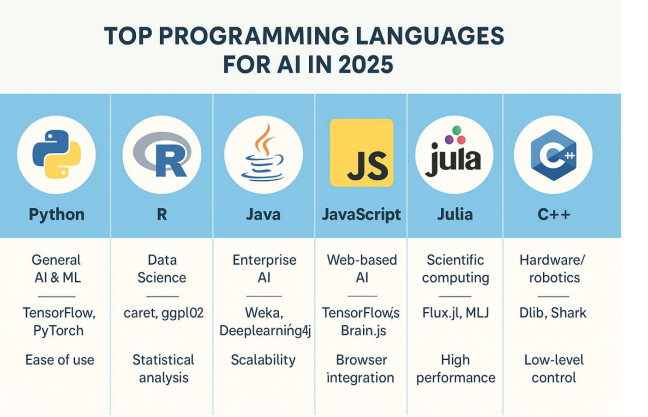
Each language excels in different aspects of AI development. Here’s a quick summary:
Python is best for general-purpose AI and machine learning.
R is ideal for statistical modeling and visualization.
Java shines in enterprise-scale AI applications.
JavaScript is great for client-side and web-based AI.
Julia provides speed for scientific and numerical computing.
C++ offers low-level control for robotics and real-time AI.
Your choice of language should align with the project’s needs, your team’s expertise, and the
tools required.
Final Thoughts
Selecting a programming language is crucial for any AI project, with Python being a popular choice for developers. However, understanding other languages can enhance performance and address specific challenges. As the AI industry expands in 2025, being proficient in multiple languages becomes increasingly valuable. Whether you’re focused on intelligent systems, web applications, research, or industrial applications, there is a suitable language for your success. Tomorrow (Day 7), we will guide you in setting up your first AI coding environment using Python and Jupyter Notebook.