
Artificial Intelligence (AI) is revolutionizing every industry—healthcare, finance, transportation, education, and even art. At the heart of this transformation lies Python, a programming language beloved for its readability, flexibility, and powerful ecosystem of libraries.
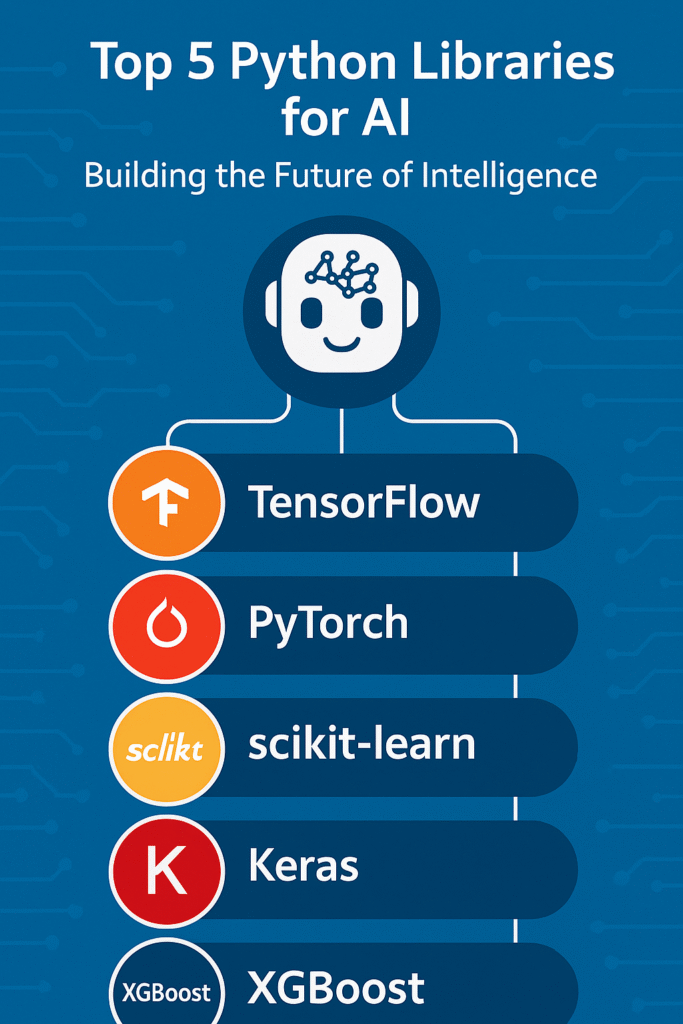
In this article, we explore the *top 5 Python libraries for AI, specifically:
Scikit-learn
TensorFlow
PyTorch
Keras
Pandas
Each library plays a unique role, from data preprocessing to deep learning and model deployment. Whether you’re a beginner or a seasoned AI developer, these libraries are essential tools in your AI journey.
Table of Contents
1. [Why Python for AI?](#why-python-for-ai)
2. [1. Scikit-learn: The Foundation of Machine Learning](#scikit-learn)
3. [2. TensorFlow: Google’s Deep Learning Giant](#tensorflow)
4. [3. PyTorch: Flexibility and Dynamic Computation](#pytorch)
5. [4. Keras: High-Level Deep Learning Made Easy](#keras)
6. [5. Pandas: Data Manipulation Powerhouse](#pandas)
7. [Honorable Mentions](#honorable-mentions)
8. [Conclusion](#conclusion)
Why Python for AI?
Before diving into the libraries, it’s important to understand *why Python is the preferred language for AI and machine learning:
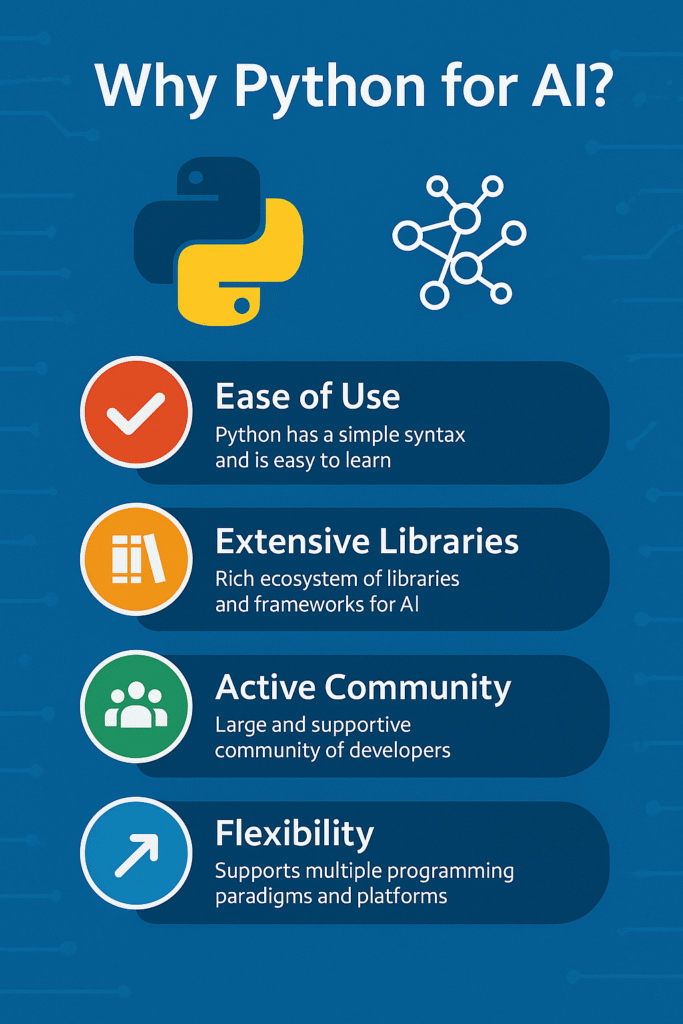
Simplicity & Readability: Python’s clean syntax makes it easy to learn and use.
Rich Ecosystem: A vast array of AI-focused libraries and frameworks.
Community Support: Strong developer communities contribute to rapid problem-solving and innovation.
Cross-platform Compatibility: Python code runs smoothly across major operating systems.
Integration with Other Languages: Python can be integrated with C, C++, Java, and more for performance boosts.
Now let’s explore the top Python libraries that are shaping the AI revolution.
1️⃣ Scikit-learn: The Foundation of Machine Learning <a name=”scikit-learn”></a>
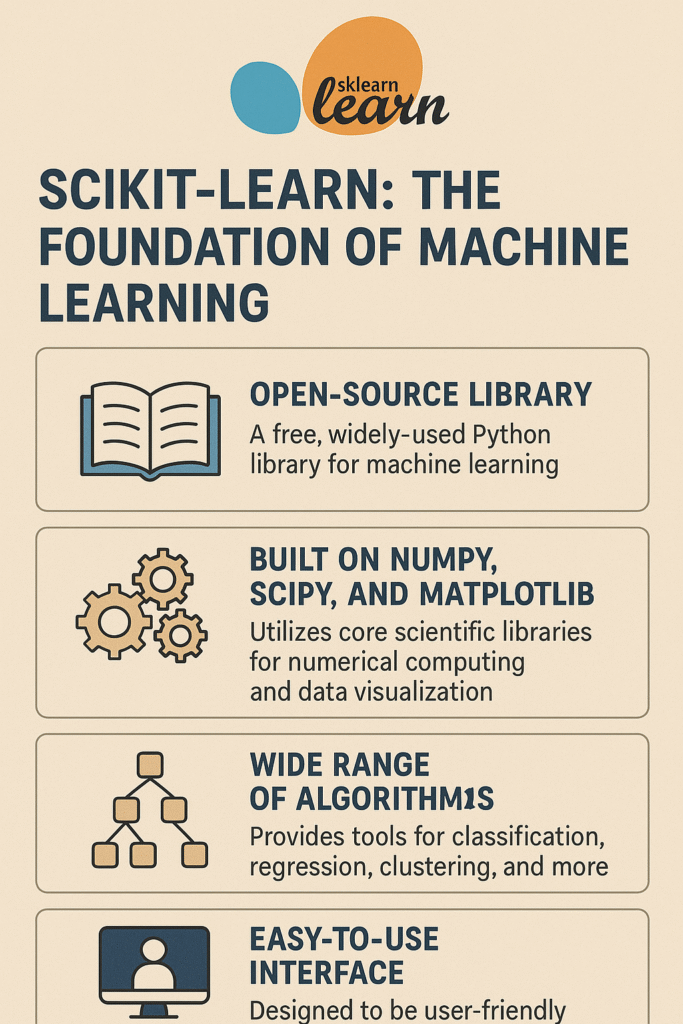
Focus: Supervised and unsupervised learning algorithms.
Use Cases:
Classification (e.g., spam detection)
Regression (e.g., predicting house prices)
Clustering (e.g., customer segmentation)
Dimensionality reduction (e.g., PCA)
Model evaluation and tuning
Overview
Scikit-learn is a Python library built on NumPy, SciPy, and matplotlib, and it is one of the most used libraries for traditional machine learning algorithms. It provides a simple interface for building, training, testing, and evaluating models.
python
from sklearn.linear_model import LogisticRegression
from sklearn.datasets import load_iris
from sklearn.model_selection import train_test_split
data = load_iris
X_train, X_test, y_train, y_test = train_test_split(data.data, data.target)
model = LogisticRegression
model.fit(X_train, y_train)
print(model.score(X_test, y_test))
Key Features
Easy to use
Wide range of ML models
Tools for model selection, tuning, and evaluation
Built-in datasets and utilities
Best For
Beginners learning machine learning fundamentals
Quick prototyping of ML models
Academic research and small-scale industry projects
2️⃣ TensorFlow: Google’s Deep Learning Giant <a name=”tensorflow”></a>
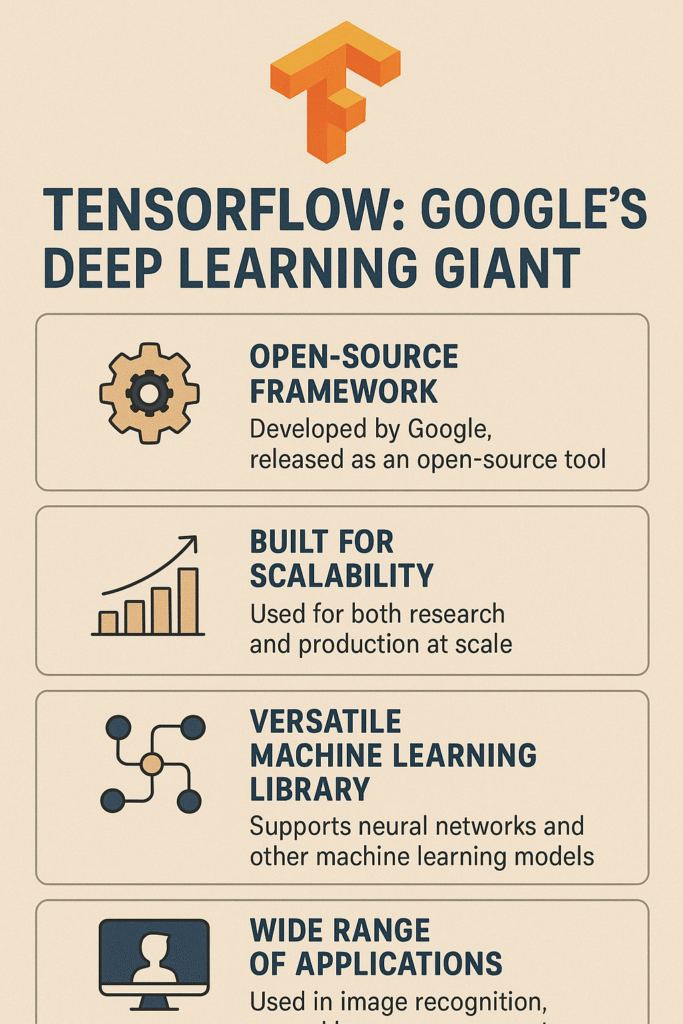
Focus: Deep learning, neural networks, production-grade AI models.
Use Cases:
Image recognition
Natural language processing (NLP)
Speech recognition
Time-series forecasting
Reinforcement learning
Overview
Created by Google Brain, *TensorFlow* is a powerful open-source library designed for numerical computation and large-scale machine learning. It uses *computational graphs* and supports *GPU acceleration*, making it suitable for complex, resource-intensive AI models.
python
import tensorflow as tf
model = tf.keras.models.Sequential([
tf.keras.layers.Dense(128, activation=’relu’),
tf.keras.layers.Dense(10)])
Key Features
High scalability (perfect for big data and production)
Supports mobile and embedded platforms (TensorFlow Lite)
TensorBoard for visualization
Pre-trained models via TensorFlow Hub
Multi-language support (Python, C++, JavaScript)
Best For
Developers and engineers building production-grade AI systems
Large-scale model training (e.g., distributed systems)
Deep learning researchers
3️⃣ PyTorch: Flexibility and Dynamic Computation <a name=”pytorch”></a>
Focus: Deep learning with dynamic computation graphs.
Use Cases:
Computer vision (object detection, segmentation)
NLP (transformers, translation)
Academic research
Generative models (GANs, VAEs)
Overview
PyTorch is an open-source deep learning framework developed by Facebook’s AI Research Lab. Unlike TensorFlow, it uses dynamic computation graphs, which makes debugging easier and the development process more intuitive.
python
import torch
import torch.nn as nn
import torch.optim as optim
class Net(nn.Module):
def __init__(self):
super(Net, self).__init__()
self.fc1 = nn.Linear(784, 128)
self.fc2 = nn.Linear(128, 10)
def forward(self, x): x = torch.relu(self.fc1(x))return self.fc2(x)model = Net()
Key Features
Dynamic computational graphs
Seamless integration with Python and NumPy
Strong community in academia
Supports GPU acceleration
TorchVision and TorchText for data loading
Best For
Research and rapid prototyping
Deep learning enthusiasts
NLP and computer vision tasks
4️⃣ Keras: High-Level Deep Learning Made Easy <a name=”keras”></a>
Focus: User-friendly neural network APIs.
Use Cases:
Building CNNs, RNNs, and transformers
Experimenting with architecture quickly
Teaching and learning AI
Overview
Keras is a high-level API for building neural networks, now tightly integrated with TensorFlow (since TensorFlow 2.0). It abstracts away much of the complexity of backend operations, making it ideal for beginners and fast prototyping.
python
from tensorflow.keras.models import Sequential
from tensorflow.keras.layers import Dense
model = Sequential([ Dense(64, activation=’relu’, input_shape=(100,)),Dense(10, activation=’softmax’)])
Key Features
Easy-to-understand syntax
Runs on TensorFlow, Theano, or CNTK (mostly TensorFlow now)
Modular and extensible
Support for convolutional and recurrent network
Rich ecosystem: Keras Tuner, KerasCV, etc.
Best For
Beginners in deep learning
Quick experimentation and prototyping
Educators and students
5️⃣ Pandas: Data Manipulation Powerhouse <a name=”pandas”></a>
Focus: Data preparation and analysis.
Use Cases:
Cleaning raw data
Exploratory data analysis (EDA)
Feature engineering
Data wrangling
Overview
*Pandas* is not a machine learning library, but it’s one of the most critical libraries for AI development. Every AI model starts with data—and Pandas makes manipulating, filtering, aggregating, and cleaning datasets simple and efficient.
python
import pandas as pd
df = pd.read_csv(‘data.csv’print(df.head())
df = df.dropna()
df[‘price’] = df[‘price’].astype(float)
Key Features
DataFrames and Series for structured data
Support for reading/writing multiple file formats (CSV, Excel, JSON)
Time series manipulation
Seamless integration with NumPy, Matplotlib, and Scikit-learn
Best For
Preprocessing before training models
Data transformation pipelines
Real-world data handling
Honorable Mentions <a name=”honorable-mentions”></a>
While the above are the top 5, many other libraries contribute significantly to the AI ecosystem:
NumPy: Fundamental for numerical computation.
Matplotlib / Seaborn: Visualization and plotting.
OpenCV: Computer vision and image processing.
NLTK / spaCy: Natural language processing.
XGBoost / LightGBM: High-performance gradient boosting.
Conclusion <a name=”conclusion”></a>
The Python AI ecosystem is vast and growing rapidly. The *top 5 Python libraries* covered—*Scikit-learn, **TensorFlow, **PyTorch, **Keras, and **Pandas*—each offer unique strengths and are often used together in AI projects.
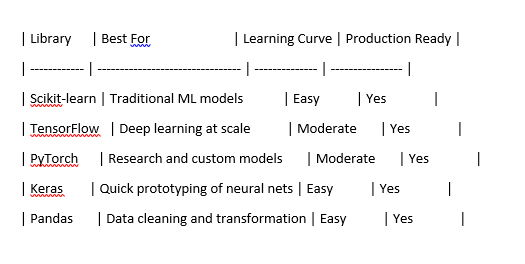
As an aspiring AI developer or data scientist, learning these libraries will unlock the doors to building intelligent systems. They are more than just tools—they are the building blocks of modern AI.