

Artificial Intelligence (AI) and Machine Learning (ML) are transforming industries, from healthcare to finance to social media. At the core of ML lie two main types of learning: *Supervised Learning* and *Unsupervised Learning*. Understanding the difference between them is key to grasping how intelligent systems learn from data.
In this detailed article, we’ll explore:
* What is Supervised Learning?
* What is Unsupervised Learning?
* Key Differences Between Supervised and Unsupervised Learning
* Real-World Examples
* Pros and Cons of Each
* When to Use Which Type?
* Visual Diagrams to Help You Understand
What is Supervised Learning?
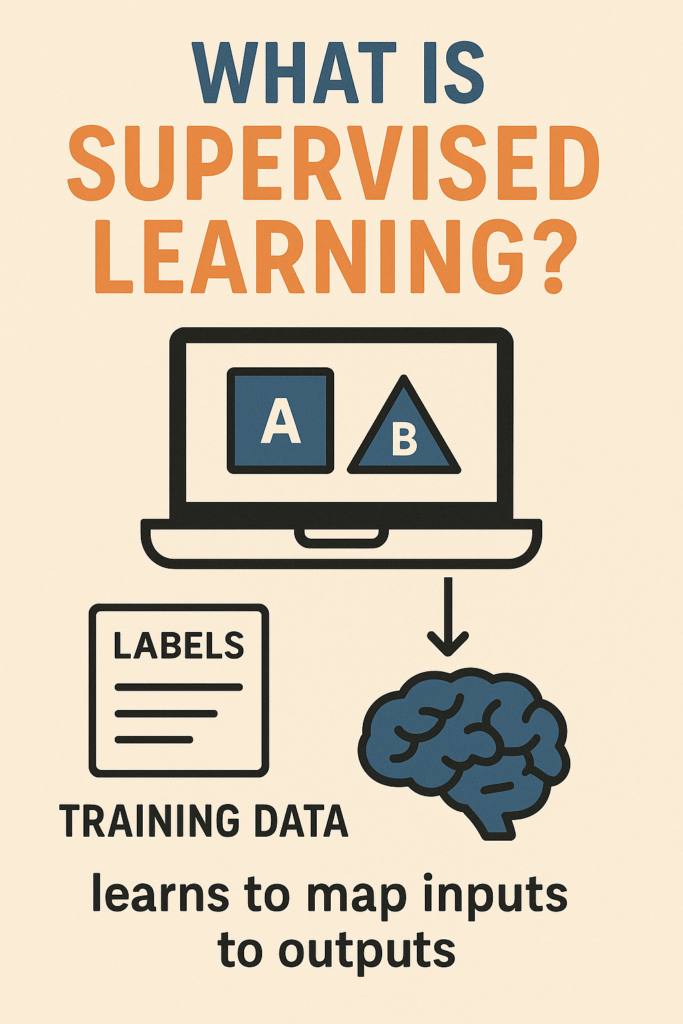
Supervised Learning is like teaching a child using a book with *questions and answers. You provide the algorithm both the **input data* and the *correct output* so it learns the mapping between the two.
Definition
Supervised learning is a machine learning technique where a model is trained on a *labeled dataset*, meaning the input comes with the correct output.
The model’s goal is to *learn a function* that maps inputs (features) to outputs (labels).
Example
Suppose you want to build a spam email filter. You have a dataset of emails labeled as *spam* or *not spam*. Your algorithm learns the patterns (like certain keywords or email structure) that indicate whether an email is spam.
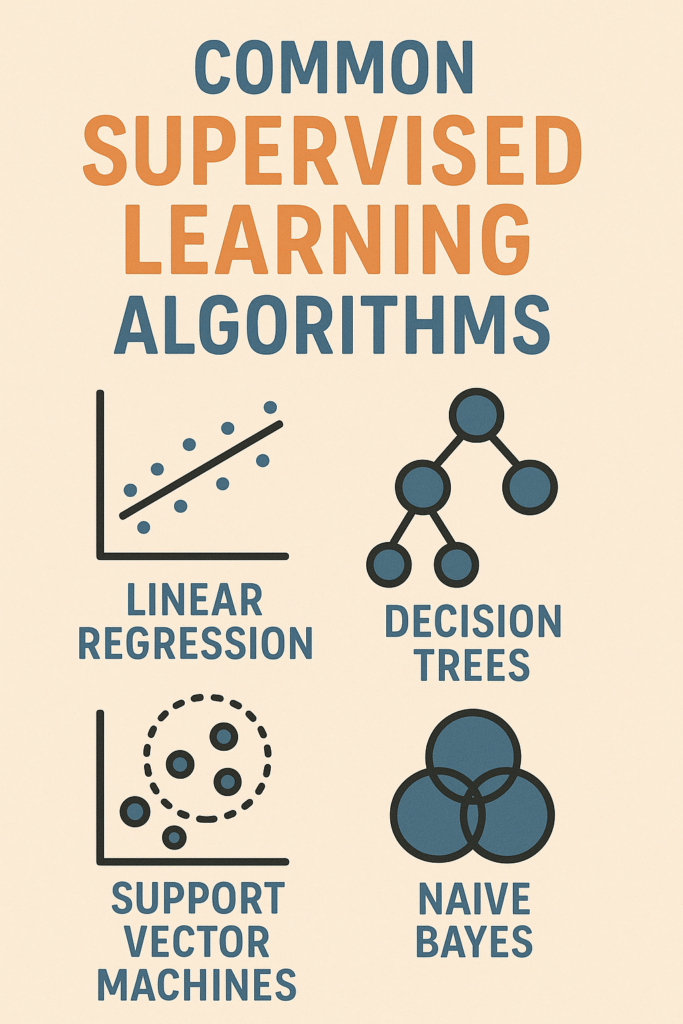
Common Supervised Learning Algorithms
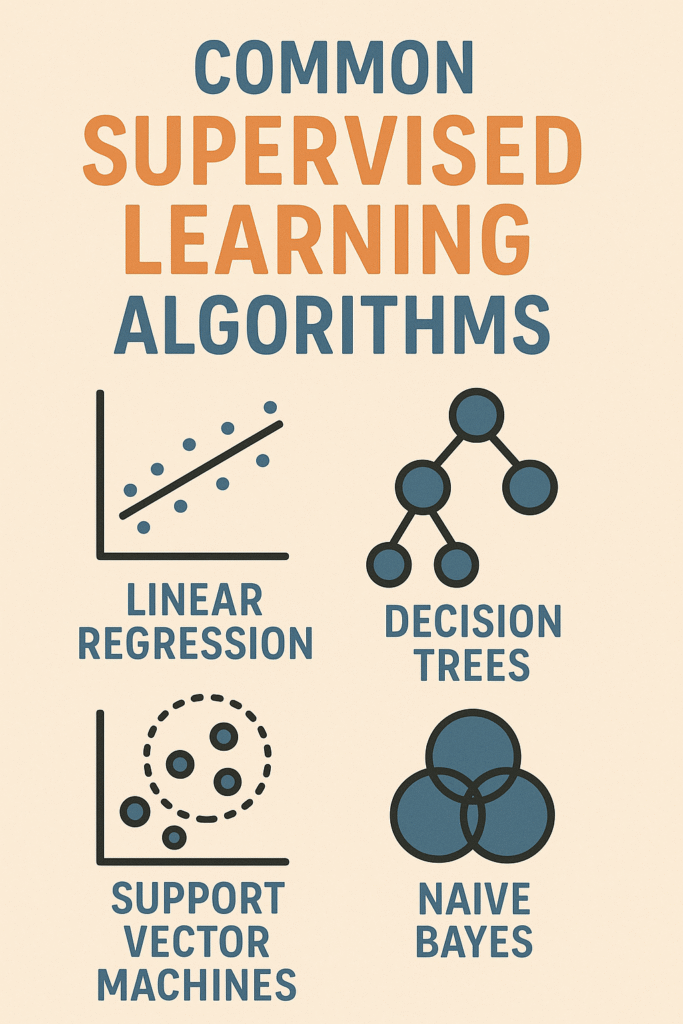
Linear Regression
Logistic Regression
Decision Trees
Support Vector Machines (SVM)
Random Forest
K-Nearest Neighbors (KNN)
Neural Networks
What is Unsupervised Learning?
Unsupervised Learning is more like giving a child a *puzzle with no picture on the box. The system must figure out the patterns in the data **without being told what the output should be.
Definition
Unsupervised learning is a type of machine learning where the model is trained using unlabeled data, and the goal is to discover hidden patterns or structures.
Example
You have a large set of customer data from an online store (age, purchase behavior, location), but no labels. Using unsupervised learning, you can group customers into segments (e.g., high spenders, bargain seekers).
Common Unsupervised Learning Algorithms
K-Means Clustering
Hierarchical Clustering
Principal Component Analysis (PCA)
Autoencoders
DBSCAN
Diagram 1: Basic Difference Between Supervised and Unsupervised Learning
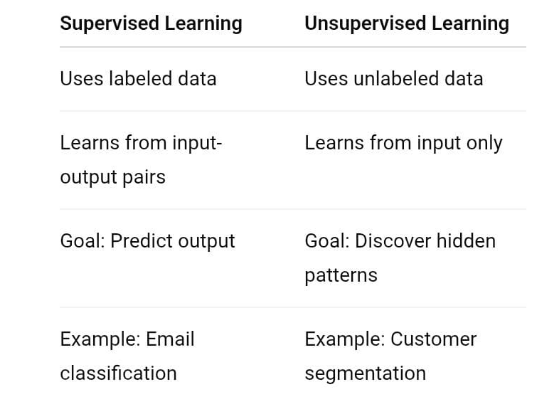
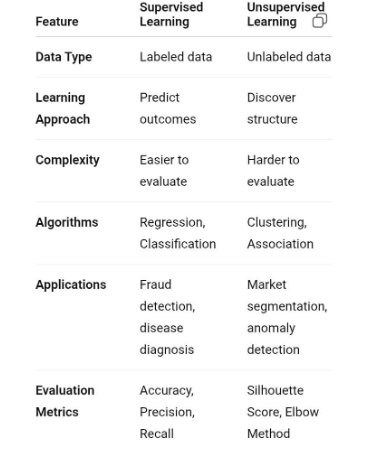
Key Differences Between Supervised and Unsupervised Learning
Real-World Applications
Supervised Learning Applications
1. Email Spam Detection – Gmail uses supervised models to classify spam emails.
2. Medical Diagnosis – Predicting whether a tumor is malignant or benign based on patient history.
3. Stock Price Prediction– Predicting future prices based on historical labeled data.
4. Image Recognition – Identifying objects in images (e.g., cats vs. dogs).
Unsupervised Learning Applications
1. Customer Segmentation – Grouping customers for targeted marketing.
2. Recommendation Systems – Finding similar products to what a user likes.
3. Fraud Detection – Discovering unusual patterns in transactions.
4. Genetics – Grouping similar genes or traits in DNA data.
Diagram 2: Example Workflows of Supervised vs Unsupervised
Supervised Workflow:
1. Collect Labeled Data →
2. Train Model →
3. Predict Output →
4. Evaluate Accuracy
Unsupervised Workflow:
1. Collect Unlabeled Data →
2. Train Model
3. Discover Structure (clusters, patterns) →
4. Interpret Results
Pros and Cons of Each
Supervised Learning
Pros:
More accurate predictions
Easy to evaluate with known labels
Powerful for classification and regression tasks
Cons:
Requires a lot of labeled data
Time-consuming to label data
Might not generalize well to unseen situations
Unsupervised Learning
Pros:
No need for labeled data
Useful for exploring unknown patterns
Good for pre-processing and dimensionality reduction
Cons:
Hard to evaluate model performance
May produce results that are hard to interpret
Can be less accurate for specific predictions
When to Use Which?
Use Supervise
You have labeled data
You need to make predictions (classification or regression)
Accuracy is crucial
Examples: Weather prediction, disease diagnosis, stock forecasting
Use Unsupervised Learning When:
You don’t have labeled data
You want to discover patterns or groupings
You’re doing exploratory data analysis
Examples: Market segmentation, anomaly detection, organizing information
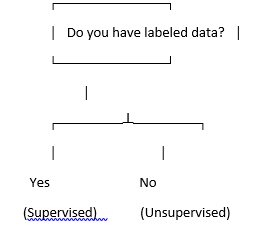
Diagram 3: Decision Tree – Supervised or Unsupervised?
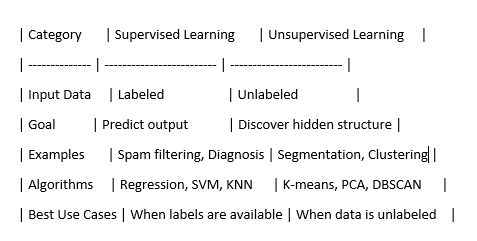
Summary
Conclusion
Understanding the difference between *Supervised and Unsupervised Learning* helps you choose the right approach for your AI projects. Whether you’re building a chatbot, a recommender system, or a data analysis pipeline, selecting the appropriate learning type can save you time and boost your model’s performance.
Both learning types play a crucial role in the AI revolution — and knowing when and how to use them is a foundational skill for any data scientist or machine learning engineer.