
Introduction
AI is strong, and every strength has its responsibility. During this session, we will discuss the
benefits and limitations of AI technology, including the Pros and Cons, and you will learn both sides of the coin and why it is
so important to remain balanced and consider ethical aspects of AI development. Understanding the Pros and Cons is crucial for informed discussions.
Today is Day 5 in the 30 days of AI challenge! We have discussed applications of AI in different
industries in the previous post and today, we are stepping back to draw a larger picture. Whilst
the world seems to be quickly reshaped by the Artificial Intelligence in an exciting manner, one
can’t ignore serious questions and issues it brings with it.
The Pros of Artificial Intelligence
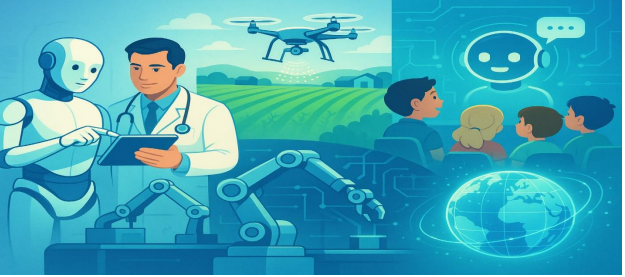
Artificial Intelligence has undeniable benefits. Here are the key advantages that make it so
transformative:
1.Automation of Repetitive Tasks
AI is best at doing repetitive, tedious tasks at great speed with precision.
Examples include:
Data processing and entry
Invoice matching
Filter on e-mail
Industrial manufacture processes
Advantage: Makes people more productive and liberates human beings to spend their time
innovating or strategizing.
2.Faster Decision-Making with Data Insights
AI has the capacity to go over large quantities of data and be capable to get patterns no person
would have noticed readily.
Used in:
Financial forecast
Market trend analysis
Fraud detection
Advantage: It assists businesses and governments to make wiser and real-time decisions.
3.24/7 Availability and Scalability
AI systems do not require any breaks or sleep as human beings would.
Applications include:
The ability to provide 24-hour leadership Chatbots
Self-governing structures such as streetlights and parcel drones
Advantage: Guarantees uninterrupted services particularly in operations being carried out on a
worldwide basis or during emergencies.
4.Enhanced Personalization
AI is able to personalize the experiences of the user.
For example:
Product Recommendation on Amazon or Netflix
Individual learning applications
Niche Advertising campaigns
Advantage: Enhances participation and happiness in the area of e-commerce, education and
entertainment.
5.Breakthroughs in Research and Development
Artificial intelligence speeds the process of discovery in multidimensional areas.
Used for:
Discovery of new drugs or new materials
Climate change modelling
Modeling of human protein folding (e.g. AlphaFold produced by DeepMind)
Advantage: Works within a shorter time span and sometimes at a cheaper price as compared to
the conventional one.
The Cons of Artificial Intelligence
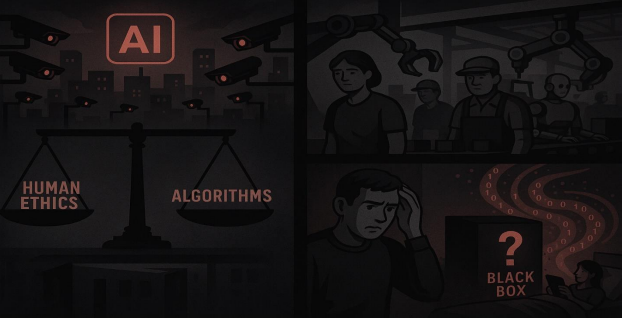
Despite its benefits, AI brings several challenges and risks:
1.Job Displacement and Economic Inequality
Artificial intelligence and automation are taking over jobs especially in manufacturing areas,
logistics and clerical work.
Example: The implementation of self-checkout machines diminishing the need of cashiers;
autonomous trucks, diminishing the need for drivers.
Risk: Economic division into two groups because only highly skilled employees win it.
2.Bias and Discrimination in AI Algorithms
AI will echo or even magnify the kinds of societal biases present in the data being employed for
training.
Examples:
Facial recognition discrimination against races
Recruitment platform weeding out women, or minorities
Zip-code–based legitimate interest–justifying credit reference models.
Risk: Unfair treatment, systemic bias and discrimination going the way of the machine.
3.Loss of Privacy and Surveillance Concerns
AI would allow collecting and monitoring large amounts of data.
Used in:
Facial recognition in the streets
Monitoring the social media behavior
Forecasting the police
Concern: Degradation of Individual rights and civil liberties.
4.Lack of Transparency (The Black Box Problem)
Even the developers cannot fully explain many of the decisions of AI models (mostly deep
learning).
Example: A model may reject a loan, and just can not say why.
Risk: Responsibility is made hard and this result to distrust or abuse.
5.Overdependence and Loss of Human Skills
The extreme dependence on AI may undermine the human problem solving and decision making
skills.
Example:
The decrease of our spatial awareness because of GPS navigation
Writing technology cutting down on writing practice
Danger: Human beings might end up being inactive consumers as opposed to thoughtful
individuals.
Bonus Concern: Existential Risks and Super intelligence
Some experts, such as Elon Musk and other groups including the Future of Life Institute caution
on the long term threat of the development of AI that would be able to surpass human
intelligence (Artificial General Intelligence or AGI).
Concern: The power of a super intelligent AI when not aligned with humankind values would
race toward something detrimental, and unpredictable.
Although this is still a speculation, it is being discussed on policy and ethics fronts.
Striking a Balance: Ethical AI and Regulation
In order to make sure that everyone can benefit because of AI, we require:
Resilient rules and systems (e.g., EU AI Act, U.S. Executive Order on AI)
Various data in order to minimize bias
Tools of transparency and explainability
Inclusive teams of development
Continuous human monitoring
Final Thoughts
Artificial Intelligence does not hold itself as either good or bad, it is a tool. Just as is the case
with any powerful tool, this tool will have its influence based on the manner in which we design
it, govern it, and also use it. In addition to conscious efforts to eliminate the risks associated with
AI, there is therefore a way we can make the AI-driven future an ethical, inclusive, and humanfriendly one by embracing its potential.