
Introduction
Welcome to Day 4 of the 30 Days of AI series! Today, we explore the exciting real-world
applications of Artificial Intelligence that are already transforming industries and daily life.
From healthcare and education to agriculture and business, AI is revolutionizing how we
live, work, and make decisions.
Let’s dive into how AI is applied across different fields and why it matters more than ever.
AI in Healthcare – Revolutionizing Diagnosis, Treatment & Patient Care
Figure 1 AI is transforming healthcare through intelligent diagnosis, predictive analytics, 24/7 patient
assistance, and faster drug discovery
Artificial Intelligence is significantly changing the health care sector and presenting new
opportunities of quick medical care, accurate and efficient medical care. AI can provide
healthcare providers with upgraded tols to make better decisions, offer personalized
treatment, and minimize human error resulting in enhanced patient outcomes.
Medical researchers as well as doctors have intelligent systems in place to assist them
instead of having to be guided strictly by manual analysis and intuition. One of the
advantages of AI systems is that they can process very large sets of information (medical
records, clinical trial outcomes, genetic profiles, and imaging data) in a few seconds,
which human beings cannot.
Key Applications of AI in Healthcare
Here are some of the most impactful areas where AI is being implemented:
Disease Prediction and Early Diagnosis
The AI models learn to find patterns in the medical images, lab reports and patient history
in order to predict the disease before their manifestation or when they are in their earliest
state.
Example:
AI algorithms can identify breast cancer, lung cancer, and skin conditions as well
as expert doctors or even better than the experienced doctors.
Diagnostic tools using AI interpret X-rays, MRI, and CT scans with an amazing
speed and precision searching in them any abnormalities
AI Chatbots for Patient Support and Triage
AI-driven chatbots and virtual assistants would be beneficial to patients in that they:
Response to simple medical questions round the clock
Scheduling appointments
Evaluating the symptoms to recommend treatable steps
Easing congestion at the emergency services
To illustrate, Babylon Health chatbot applies first-level triage and provides instructions
on health care, depending on the symptoms the consumer enters.
Drug Discovery and Vaccine Development
The process of creating a new drug is usually 10+ years long and it costs billions of
dollars. AI makes it even faster by:
Processing of complex chemical structure
Forecasting the interaction between various compounds
Determining possible candidates of new treatment
Helping to develop COVID-19 vaccines (e.g., Modern with the help of AI was
able to accelerate the early design of its vaccines)
Remote Patient Monitoring and Wearables
As wearable devices (such as smartwatch and fitness trackers) become more popular, AI
analytics may track the vital signs instantly and notify the doctor or caretaker about the
deviations:
Heart rate, oxygenation, blood sugar level, sleeping patterns
Particularly helpful with regard to handling chronic disorders, such as diabetes,
high blood pressure and heart problems
Decreases the necessity to visit the hospital frequently
The Apple watch and Fitbit watches now have health trends and alerts based on AI,
which allows the patients and doctors to monitor the progress of the condition.
Real-World Example: IBM Watson Health
One of the most advanced applications of AI helping care providers requires mentioning
IBM Watson Health. It:
Scan numerous medical studies papers in matter of seconds
Parses health data in patients
Recommends individual treatment plans with the current evidence
Applications in oncology (cancer treatment), radiology and genomics
Watson is not a replacement of the doctors but rather an empowerment tool that gives
more information and evidence-based suggestions to a physician in order to make faster
decisions.
Benefits of AI in Healthcare:
Accelerates treating and diagnosing
Decreases diagnosing mistakes
Increases access to care (particularly at remote locations)
Reduces expenses through efficiency in processes
Capable of facilitating preventive health care with early warning system
AI in Education – Personalizing Learning and Powering Smart Classrooms
Artificial Intelligence is touting changes in the learning process of school children and
the teaching methods of educators and the structure of educational organizations. Thanks
to AI, learning is more personal, more inclusive, more data-based, and more accessible
than before.
Teaching traditionally has been a one-size-fits-all approach; however, AI will enable
learning to be made more individual and enables students to get resources that meet them
at their pace and ability levels and interests. Teachers, in turn are able to be more mentors
and less paper pushers.
Key Applications of AI in Education
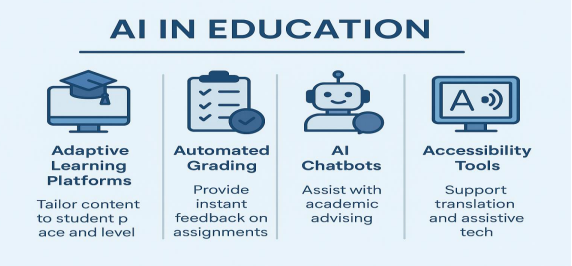
Adaptive Learning Platforms
AI-powered platforms analyze student performance in real-time and dynamically adjust:
The difficulty level of questions
Topics reviewed based on weaknesses
The pace of content delivery
For example, a student struggling with algebra may receive simpler explanations and
more practice problems, while advanced learners progress faster.
Tools like Socratic by Google or Smart Sparrow personalize the learning experience
using machine learning algorithms.
Automated Grading and Feedback
AI has the ability to correct multiple choice quizzes, short answers and even essays,
taking away hours of so-called manual labor on the part of the teacher.
Immediate response leads to the students learning quicker
Teachers are provided performance analytics in order to determine areas of
weakness
Secured objective, consistent assessment
Assignment’s assessment, plagiarism checking, and performance monitoring tasks are
carried out with the help of AI tools, such as Grade scope and Google Classroom.
AI Chatbots for Academic Advising
AI chatbots are being used by universities, and schools to manage:
Course recommendations
Schedule planning
Rotational schedule (to handle FAQ (admissions, fees, deadlines))
Such virtual assistants may work around the clock, making students feel more satisfied
and relieving their human employees.
Case: The chatbot Pounce that Georgia State University implemented assisted in
decreasing summer melt by assisting the students during the enrollment process and
facilitating paperwork.
Language Translation and Accessibility
The language and disability barrier is broken with the help of AI:
Converting of educational materials to various languages
Converting speech into text (beneficial to students with hearing impairment)
Reading to children who are visually impaired or have dyslexia
Example: Microsoft Immersive Reader translates phrases and reads the text aloud,
highlight words via AI technology use, and encourages inclusion.
Real-World Examples: Coursera and Duolingo
Coursera has resorted to using AI to:
Propose individualized courses tracks
Proposals review material on the outcomes of the quizzes
Give auto graded homework (feedback)
Duolingo, an application of learning languages, applies AI to:
Choose the challenge to your level
Word reviews (spaced repetition): make appropriate memories of the word
Use smart reminders and gamification to encourage consistency
Benefits of AI in Education:
Allows self-paced learning at any level of skills
Enables better access among various learners
Automation by reducing the workload of teachers
Will provide data information in terms of providing better curriculum planning
Increases interaction with tools in students
In summary, AI in education is not replacing teachers—it’s augmenting them. It
empowers educators to focus on what matters most: mentoring, creativity, and human
connection, while AI handles the repetitive, data-heavy tasks.
AI in Agriculture – Cultivating a Smarter Future
Agriculture as old as it is in the world is yet experiencing a transformation due to
advancement in technology-Artificial Intelligence. With a greater global population and
climate change putting a question mark on food production, AI is becoming one of the
key mechanisms to help with sustainable, efficient and data-driven farming.
With AI, farmers can make accurate choices, minimize waste, use resources more
efficiently, and increase output on a larger scale- higher yields, quality of crops, less
harm to the environment.
Key Applications of AI in Agriculture
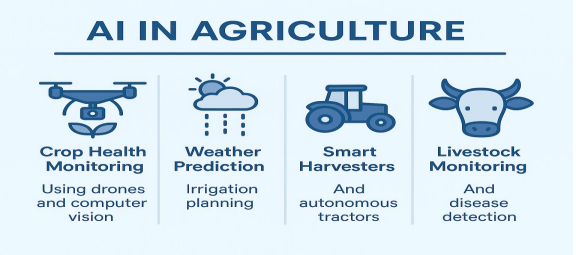
Crop Health Monitoring and Disease Detection
AI-powered drones and computer vision systems use high-resolution images and sensor
data to:
Identify plant diseases or insect infestation at an early stage
Check the health of crops by appearance or color, texture, or growth rate
Accordingly offer field level information in a manner such that farmers are able to
act upon them immediately
An example of this is, where AI systems trained about thousands of photos of plants can
accurately identify disease-causing factors such as blight or mildew with precision up to
90 percent even before the farmer can sense it.
Weather Prediction and Irrigation Management
Machine learning models analyze weather patterns, soil conditions, and historical data to:
Better estimations of rainfall and droughts
Recommend the best watering periods on crops
Prevent excessive use of water and water wastages
With the help of AI, smart irrigation systems assist agricultural producers in cutting down
on the amount of water consumption by 30 that the program cannot read up to 50 percent
without affecting harvesting.
Smart Harvesting and Autonomous Machinery
Artificial intelligence-based robots and tractors are able to:
Deploy mobile automation in fields, with GPS and sensor technology’s ability to
navigate without supervision
Find crops in a state to be harvested
Do planting, seeding, spraying and harvesting with little human intervention
Robotic harvesters are able to work round the clock, which maximizes peak harvest
seasons and minimizes over-reliance on seasonal workers.
Livestock Monitoring and Health Management
Artificial intelligence does not apply to crops alone, but it also controls the wellbeing and
efficiency of livestock:
Monitoring and feedback with sensors and wearables track the feeding patterns,
movements and temperature.
AI identifies indicators of disease, stress or abnormal animal behavior.
Farmers are alerted to act preventively before the diseases propagate further.
Some dairy farms use AI to optimize feeding schedules and monitor milk production
using real-time data analytics.
Real-World Example: John Deere
John Deere, which is a multinational company in the manufacture of agricultural
machinery, has adopted the use of AI by engaging in smart tractors and precision farming
equipment. Their artificial intelligence:
Implement the computer vision to identify the weeds and spray the herbicides at a
necessary spot
Use precision tractors that have GPS to seed and turn accurately
. Exploit soils data to change planting patterns and fertilizer applications
This not only increases yield but also reduces operational costs and environmental
impact.
Benefits of AI in Agriculture:
Precision farming: It increases the crop yield.
Minimizes loss of fertilizers, pesticides and water.
Reduces expense on labor through automatization.
Gives early forecasts to avoid losses of crops and livestock.
Allows the practice of sustainable agriculture in climate difficulties.
In summary, AI in agriculture is enabling farmers to farm smarter, not harder. With
access to real-time insights and automated tools, they can make informed decisions that
benefit both their income and the planet.
AI in Business and E-Commerce – Making Smarter, Faster Decisions
The use of Artificial Intelligence is disruptive within the manner, in which businesses and
online platforms will operate. Through automation of some of the core tasks, hyperpersonalized customer experiences as well as enabling companies to become efficient,
more customer-centric and better prepared to meet the demands of the market, AI is
assisting businesses to overcome numerous obstacles in their way.
Artificial intelligence surges and prospers in such a digital economy that requires high
speeds when processing a large amount of information and gaining insights in real-time.
These AI tools can enhance the decision-making process, customer service, and increase
revenue whether you operate an international business or a local e-commerce company.
Key Applications of AI in Business and E-Commerce
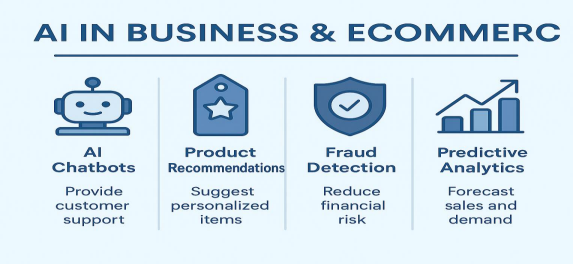
Chatbots and Virtual Assistants for Customer Service
AI-powered chatbots can:
Handle customer queries 24/7
Provide instant responses to FAQs (e.g., shipping, returns, pricing)
Route complex issues to human agents
Personalize support based on user history
For example, H&M’s chatbot helps customers find clothing items, check order status, and
get fashion recommendations—all without needing a live agent.
Benefits:
Reduced response time
Lower customer service costs
Improved customer satisfaction and retention
Personalized Product Recommendations
AI analyzes customer behavior, browsing history, and purchase patterns to offer tailored
product suggestions:
“Customers who bought this also bought…”
“Recommended for you” sections on homepages and emails
Re-targeting ads with products you’ve shown interest in
Example: Amazon’s recommendation engine contributes to over 35% of its total revenue
by showing products based on AI-driven predictions.
Other platforms like Flipkart, AliExpress, and Etsy use similar recommendation systems
powered by machine learning algorithms.
Fraud Detection and Risk Assessment
Machine learning systems will be able to identify strange or suspicious trends in
customer behavior and financial transaction processes. It is applied:
Banking and FinTech to identify credit card frauds or account hacking
E-commerce to indicate fake reviews or suspicious behaviors of users
Auto risk score and anomaly insurance
As an example, PayPal employs AI to study billions of transactions in real-time, identify
the instances of fraud, and mitigate financial losses as well as preserve the users.
Predictive Analytics for Inventory, Demand, and Pricing
AI helps businesses predict:
What products will sell, and when.
How much stock is needed in each warehouse?
Which items to promote or discount.
By identifying sales patterns, seasonality, and customer behavior, AI enables:
Dynamic pricing to adjust prices based on demand
Just-in-time inventory to avoid overstocking or understocking
Example: Retailers like Walmart and Zara use AI to adjust inventory levels and price
points in real-time across thousands of stores and locations.
Real-World Example: Amazon’s AI Ecosystem
Amazon is one of the world’s best examples of AI-powered e-commerce. Here’s how
they use AI:
Alexa: Voice-powered shopping and smart home control
Product Recommendations: Increase sales and customer satisfaction
Logistics Optimization: AI predicts the fastest delivery routes and packaging
combinations
Amazon Go Stores: Use computer vision and AI for cashier-less checkouts
Together, these technologies make Amazon more efficient, cost-effective, and customerfriendly.
Benefits of AI in Business:
Enhances customer experience with personalization and speed
Reduces operational costs by automating repetitive tasks
Enables data-driven decisions for marketing, logistics, and finance
Increases conversion rates and customer loyalty
Strengthens cybersecurity and fraud detection
In short, AI is the silent engine behind many of the smartest business strategies today.
Whether it’s recommending the perfect product, forecasting sales, or chatting with
customers at midnight, AI makes business faster, more personal, and more profitable.
AI in Transportation – Navigating the Future with Intelligence
Many experts believe that Artificial Intelligence is transforming the transportation sector
by rendering transport safer, smarter, faster, and more efficient. With self-driving cars or
autonomous delivery services, traffic forecasting, or fleet management, AI has become an
effective solution to some of the most complicated issues in transport.
With people spending more time in traffic jams and urgent needs to quickly deliver
things, AI-based systems are becoming the solution to traffic flow optimization, carbon
reductions in cities, and the safety of citizens and the shift of mobility towards a new
dimension.
Key Applications of AI in Transportation
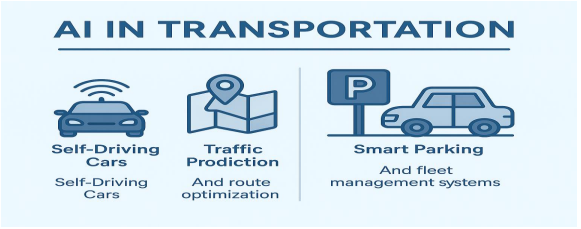
Self-Driving Cars and Autonomous Delivery Vehicles
Autonomous vehicles involve AI in their core as it helps them:
Identify road signs, street pedestrians and cars by computer vision
Forecast and act on up-to-the-minute traffic types of conditions
Decide in an instance to prevent accidents
Self-driving cars rely on tracked car models that, with the help of multiple sensors
(LiDAR, radar, GPS, Cameras) and Deep Learning algorithms, can monitor the
surrounding environment and drive without human control.
An example is the Tesla Autopilot that uses AI and deep neural networks to help with
lane keeping, self-parking, adaptive cruise control, and automatic lane changes.
Other companies like Waymo, Cruise, and Nuro are testing autonomous taxis and
delivery robots.
Traffic Prediction and Route Optimization
AI models can analyze:
Historical traffic patterns
Live GPS data
Accident reports
Weather conditions
…to suggest faster, safer, and more fuel-efficient routes in real time.
Google Maps and Waze use AI to predict congestion and reroute users based on real-time
traffic flow.
Logistics companies like FedEx and UPS use AI to optimize delivery routes—saving
time, fuel, and resources.
Smart Parking and Fleet Management
The benefits of AI in the parking and the fleet management of urban mobility areas
include:
Finding of free places to park with sensors or cameras
Forecasting on peak demand and thus guiding drivers based on that forecast
Tracking of fleet positioning, fuel consumption, the driving behavior and
maintenance requirements
To illustrate, Uber and Lyft deploy AI to pair drivers and clients, calculate fares and
shorten queues using predicted surges.
Companies such as DHL rely on artificial intelligence to streamline delivery routes and
cut down on fuel in huge transportation systems.
Real-World Innovations: Tesla & Beyond
While Tesla is a leader in semi-autonomous vehicle technology, AI in transportation goes
beyond self-driving cars:
Waymo has tested fully driverless taxis in select cities
Amazon uses AI-powered delivery robots and drones for last-mile delivery
China has implemented AI-managed traffic lights that reduce traffic jams by up to
30%
Benefits of AI in Transportation:
Reduces accidents by enabling safer vehicle behavior
Cuts fuel consumption and emissions via smarter routes
Saves time and costs for logistics and delivery companies
Improves public transportation systems through predictive analytics
Enables mobility for the elderly and disabled via autonomous transport
In summary, AI is not just changing how we drive—it’s redefining how we move. From
smart roads to intelligent fleets and autonomous rides, AI is steering the world toward a
more connected and efficient future of transportation.
Final Thoughts
AI is no longer a futuristic concept—it’s already here, powering breakthroughs across
industries. As these technologies mature, they will continue to improve lives, enhance
productivity, and tackle global challenges.
In Day 5, we’ll explore the pros and cons of AI—why some people celebrate it, while others
are cautious about its rapid growth.