
Introduction
Welcome to Day 2 of the 30 Days of AI blog series! Yesterday, we learned what Artificial
Types of Ai and how it’s shaping our everyday lives. Today, we’ll explore the three
major types of AI based on how intelligent and capable they are.
AI isn’t a single type of technology. It exists at
different levels of intelligence and functionality.
Some AIs can only do specific tasks, like
recommending YouTube videos, while others (in
theory) could think and make decisions like humans—or even beyond human intelligence.
Understanding these categories is key to separating realistic AI systems from science fiction.
Let’s explore:
Types of AI Based on Capability
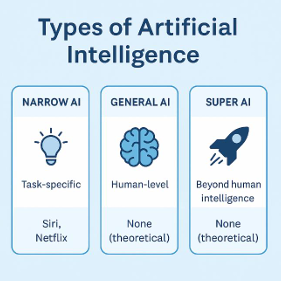
AI can be classified into three main categories:
- Narrow AI (Weak AI)
- General AI (Strong AI)
- Super AI
Each type represents a different stage of
development—from basic to futuristic. Let’s
explore each in depth.
Narrow AI (Weak AI)
Narrow AI is also called Weak AI because it is focused on one specific task. This is the only
type of AI that exists today in the real world.
What is Narrow AI?
Narrow AI systems are trained to do one job, such as:
- Recognizing faces
- Translating languages
- Recommending products
- Predicting weather
They are very good at their task, but they cannot learn anything outside their training.
Real-World Examples of Narrow AI
- Google Translate – Translates text between languages.
- Netflix & YouTube – Recommends shows and videos based on your viewing habits.
- Facial Recognition – Unlocks your phone with your face.
- Spam Filters – Filters junk emails using pattern recognition.
- z – A conversational model trained to generate human-like responses.
Current Use of Narrow AI
Narrow AI is everywhere—from mobile apps to security systems to customer service chatbots.
It may seem intelligent, but it doesn’t truly “understand” anything—it’s just following patterns
from its training data.
Key Point: Narrow AI can’t think outside its programming. It doesn’t “know” what it’s doing—
it’s just doing it well.
General AI (Strong AI)
General AI (or Strong AI) is the next stage of artificial intelligence. It is still theoretical—
meaning we haven’t built it yet.
What is General AI?
General AI would be able to:
- Understand and learn anything a human can
- Adapt to new situations
- Use logic and reasoning
- Transfer knowledge from one area to another
Basically, it could function as a human mind inside a machine.
Characteristics of General AI
- Can solve math problems AND write poetry
- Can drive a car AND teach a class
- Learns continuously from experience
- Makes moral and ethical decision.
Why Don’t We Have It Yet?
Building General AI requires:
- Human-level understanding
- Emotional intelligence
- Common sense reasoning
- Ability to generalize across tasks
These are extremely hard to teach machines. Researchers are trying—but it may take decades.
Thought Experiment: If an AI could pass a university entrance exam, solve a legal case, and
empathize with a patient—it would be General AI.
Super AI
Super AI is the most advanced and speculative type of artificial intelligence. It would not only
match but surpass human intelligence in every field—including science, art, relationships,
emotions, and innovation.
Super AI doesn’t exist. It’s purely theoretical (for now).
What Can Super AI Do?
- Solve problems faster and better than humans
- Think creatively and independently
- Understand human emotions better than we do
- Operate without human input
Examples in Fiction
- Skynet (Terminator) – Becomes self-aware and tries to wipe out humanity.
- Ultron (Avengers) – Decides to destroy humans to save the planet.
- Jarvis (Iron Man) – A helpful AI assistant who later becomes Vision.
Why Super AI is Controversial
- Could it replace humans in every field?
- Could it go out of control?
- How would we regulate it?
- Who owns it? Who teaches it ethics?
These questions make Super AI a hot topic in AI ethics, law, and policy.
Summary Table: Comparing AI Types
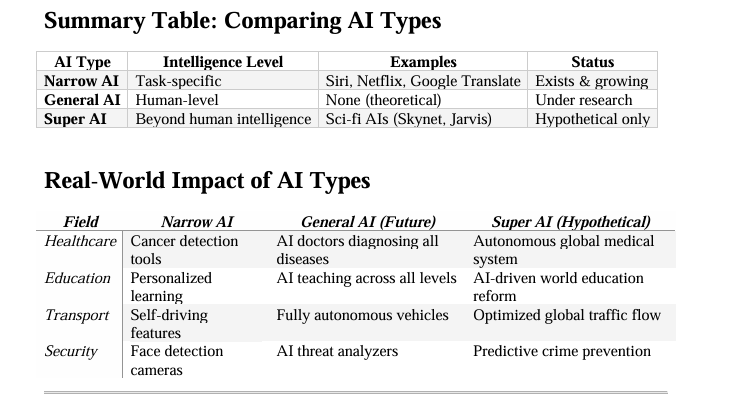
Summary
To wrap up:
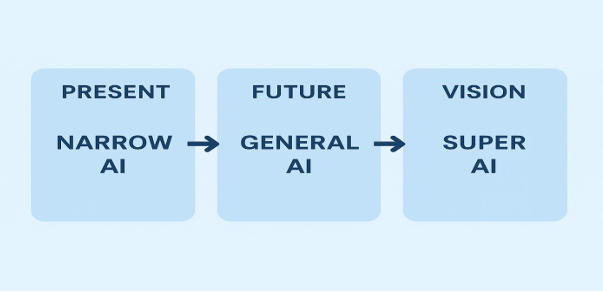
- Narrow AI is today’s reality—helpful, powerful, but limited.
- General AI is the next frontier—machines that think and adapt like humans.
- Super AI is the sci-fi dream (or nightmare)—superior, self-aware intelligence.
These three types define the evolution of AI and guide researchers, developers, and policy
makers as we build the future.
I’m enjoying learning about AI. It’s interesting to see how it can help in daily life.